Industrial 3D Scanning Technology: A Guide to 3D Digitization
Introduction
3D scanning has made significant strides in recent years and has become an indispensable tool across various industries. From the automotive industry to aerospace and medicine—the possibilities are endless. But what exactly lies behind 3D scanning technology? In this article, we take a detailed look at the mechanisms that drive this revolutionary technology.
Fundamentals of Industrial 3D Scanning Technology
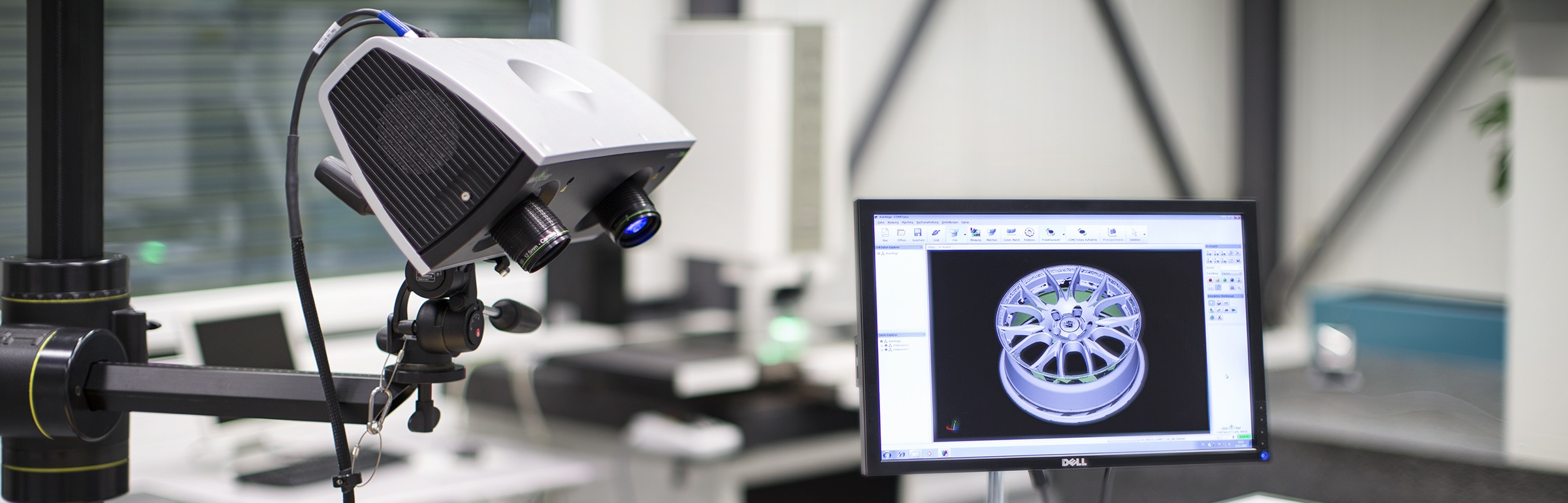
3D scanning is a process in which a physical object or environment is captured and converted into a digital form. The technology uses various types of sensors and algorithms to capture an object’s geometry. The most common methods are:
Light-section method: In this method, a beam of light is projected onto the object, and the distortion of the light is measured.
Laser scanning: A laser beam scans the object, and a sensor measures the time it takes for the laser beam to return from the object.
Photogrammetry: This method uses photos taken from different angles to create a 3D model.
Benefits of 3D Digitization
3D digitization offers numerous advantages, including:
-
- Precision: This technology enables accurate measurements.
-
- Time efficiency: The ability to scan and model in a very short amount of time.
-
- Versatility: From small components to large structures, almost anything can be scanned.
Areas of Application
3D digitization is used in:
-
- Quality Control: In manufacturing, it enables quick and accurate inspection of components.
-
- Medicine: For the fabrication of prosthetics or the planning of surgeries.
Conclusion
The technology behind 3D scanning is complex. But the benefits that 3D scanning offers in the field of 3D digitization are immense. It is revolutionizing the way we capture and understand objects and will continue to impact numerous industries.
For more information and professional 3D scanning services please us for a no-obligation consultation.
We’d be happy to advise you!
We would be happy to provide you with personalized advice, with no obligation.
Please contact us.